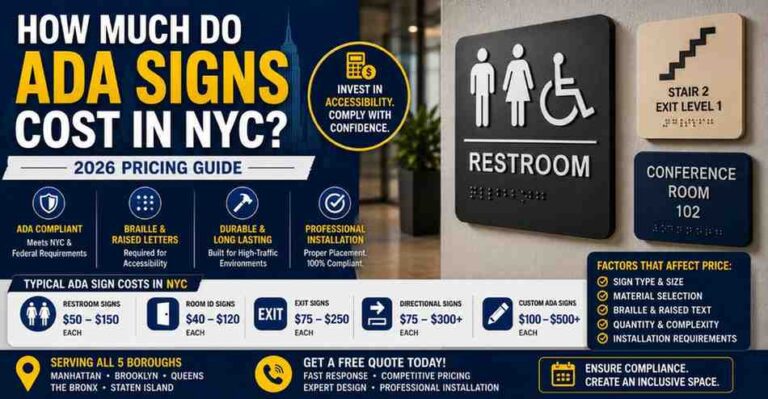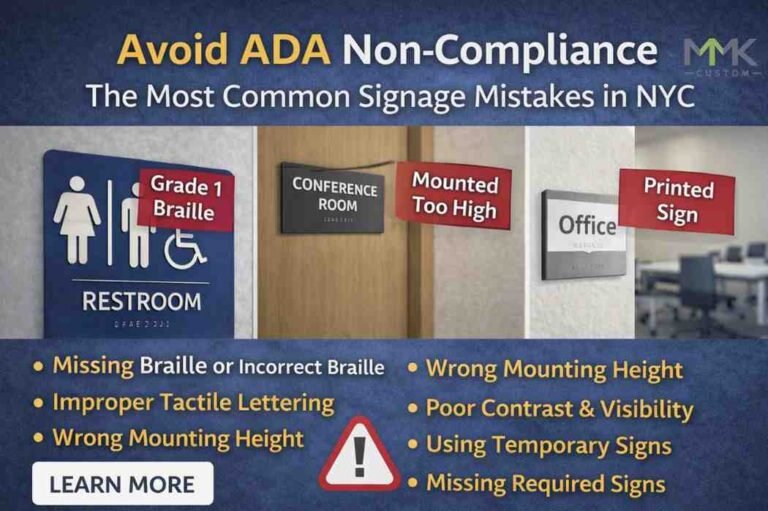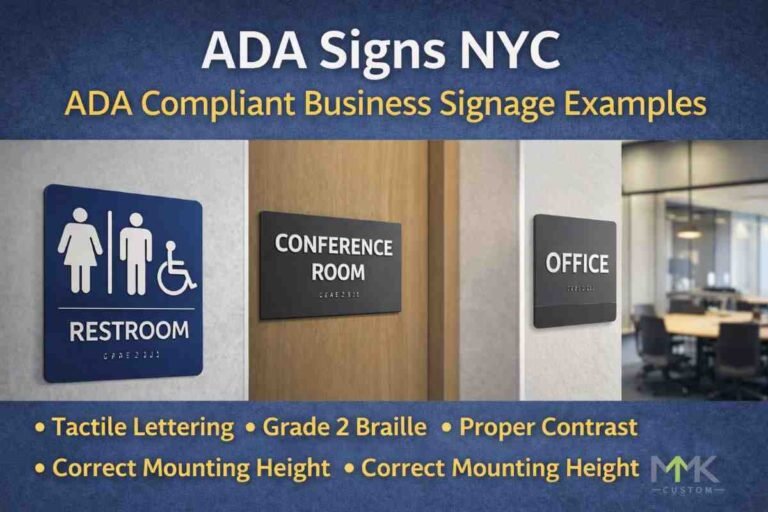

When designing signage for your business in New York City, ensuring ADA compliance isn’t just good practice; it’s the law. But one common area of confusion lies between ADA bathroom signs and room identification signs. Both play essential roles in accessibility and navigation, yet they serve distinct purposes and follow different design standards under the ADA sign requirements in NYC.
In this blog, we’ll break down the key differences, design standards, and how to stay compliant while maintaining your brand’s professional image.
What Are ADA Bathroom Signs?
ADA bathroom signs identify restrooms that are accessible to all individuals, including people with disabilities. These signs are legally required in public facilities and must follow specific tactile and visual guidelines, including:
- Raised text and Braille: Characters must be tactile (⅙ inch thick) and paired with Grade 2 Braille below the text.
- High contrast: Text and symbols must be clearly visible against the background.
- Universal symbols: Restroom icons (male, female, unisex, wheelchair) are standardized for instant recognition.
- Mounting height: Signs must be placed 48–60 inches above the floor on the latch side of the door.
ADA bathroom signs aren’t just about compliance—they’re a statement of inclusivity and care for all visitors.
What Are ADA Room Identification Signs?
While bathroom signs label restrooms, room identification signs are used throughout buildings to mark permanent rooms and spaces like offices, meeting rooms, storage areas, or kitchens.
To comply with ADA sign requirements NYC, these signs must include:
- Permanent room name or number in tactile text and Braille.
- High-contrast color scheme for easy readability.
- Consistent placement beside the door at uniform height throughout the facility.
Unlike temporary or changeable signs (like cubicle nameplates), these remain fixed as long as the room’s purpose does not change.
Key Differences Between Bathroom and Room ID Signs
| Feature | ADA Bathroom Signs | ADA Room Identification Signs |
|---|---|---|
| Purpose | Identify accessible restrooms | Identify permanent rooms or spaces |
| Symbols | Standard restroom icons | Typically text or room numbers |
| Braille Requirement | Mandatory | Mandatory |
| Mounting Height | 48–60 inches | 48–60 inches |
| Design Flexibility | Some customization allowed | Must maintain consistency throughout facility |
Both sign types must meet ADA’s tactile, Braille, and contrast requirements, but differ in icon usage and intent.
Designing ADA Signs That Match Your Brand
At Signage NYC, we understand that compliance doesn’t mean compromising on design. Our ADA-compliant signs are customized to align with your interior aesthetic—whether you prefer sleek metal finishes, acrylic layers, or vibrant color palettes.
Our experts ensure every detail from font choice to installation height meets ADA sign requirements in NYC while enhancing your brand identity.
Stay Compliant and Make a Lasting Impression
Whether you need restroom accessibility signs or full building identification systems, ADA-compliant signage ensures everyone feels welcome and can navigate your space with confidence.
👉 Learn more about our ADA Signs in NYC.
👉 Have questions about installation or design? Contact Us.
👉 Ready to start your project? Get a Quote.